


Over the past year or so, we’ve had some version of the same conversation over and over again.
A founder has built a strong business, but growth has slowed and the old tactics aren’t working. The team sees opportunity everywhere in AI, but can’t agree on where to place its bets. The board and investors are getting frustrated or losing faith because the fundamentals aren’t where they need to be, and the path forward isn’t clear.
These companies aren’t broken. They’re simply at a crossroads. Perhaps market dynamics have changed. Or the company has hit a typical growth plateau, where the things that worked previously just stop working.
We know that feeling because we’ve lived it.
We’ve been services executives. We know what it’s like to try and figure out the next move during times of change, to balance growth and profitability. We’ve sat in the boardroom celebrating the wins, but also explaining why numbers aren’t hitting the plan. More recently, we’ve been the board members asking the questions, working alongside teams to determine what will create the most value and greatest return for shareholders. We know services businesses can be messy and difficult to scale, but the world needs them. Especially now.
It’s why we’re officially launching Tercera Advisory.
This work isn’t new for us.
For the last five years, Tercera has been known primarily as an investor that provides capital, counsel and connections to technology services firms. But capital is the easy part. The main reason CEOs and founders choose to work with us is because we understand the pressures first-hand. They’re looking for a partner to help sharpen strategy, build growth and talent engines, develop leaders, and prepare the team for what’s next.
Over time, companies outside our portfolio began asking for that same help.
Some were referred by investors or bankers. Others came through our community of services leaders and advisors. They came to us because they needed a domain expert who could bring practical advice, not a $300,000 strategy deck from Bain or McKinsey.
So, in many ways, Tercera Advisory isn’t a brand-new idea. It is a formal extension of work we’ve already been doing. Work that we believe people need more than ever.
To be clear, we are not moving away from investing. Tercera Capital will continue investing in AI-native and growth-stage technology services firms. We will continue to look for great tech-enabled platforms, and increasingly, earlier stage bets on AI-native firms.
To be clear, we are not moving away from investing. Tercera Capital will continue investing in AI-native and growth-stage technology services firms. We will continue to look for great tech-enabled platforms, and increasingly, earlier stage bets on AI-native firms. Companies like Tribe AI and Auctor, which we recently invested in.
Advisory, in many ways, is the perfect complement to our investment arm. It allows us to get to know founders who might not be ready (yet) to take on new capital, and add value at a time when it’s needed most. With Advisory we can also broaden the depth and reach of our research and thought leadership, expand our annual Tercera Leadership Retreat, and put our extensive talent network to work.
How We Work
We’ve deliberately built Tercera Advisory to be the kind of AI-native, value creation firm that founders and investors WANT to work with in today’s environment.
That last thing people need right now is months of extended discovery, an impressive presentation, and a long list of things the management team must do after the consultants leave with no depth on ‘how’ to do them.
Instead, leaders and investors need help getting to an answer fast. They need an honest view of what is and isn’t working, and someone who can challenge assumptions without six months of analysis that isn’t learning everything through Claude. Most importantly, they need someone who can work alongside the team to deliver the outcomes.
Our work typically starts with a short discovery phase designed to build a clear fact base of what’s happening, with a view into the root causes, not just the symptoms. Then we work alongside the teams to co-design solutions or new strategies. Through this facilitated process, we create real alignment and guide the team to prioritize and make choices. Focusing on the areas that matter most.
We work alongside the teams to co-design solutions or new strategies. Through this facilitated process, we create real alignment and guide the team to prioritize and make choices. Focusing on the areas that matter most.
From there, we build the plan alongside the people responsible for delivering it, with clear owners, measures and near-term actions. In many cases, that means a practical 90-day plan tied to a longer-term strategy.
We often stay involved as the work moves forward at the request of the CEO or investor, helping teams adapt as they learn, maintaining accountability, or diving into workstreams alongside SMEs that we bring in to drive results. Because we believe firms should be measured by outcomes, not just output.
Where Advisory Can Help
Our work generally falls into four connected areas.
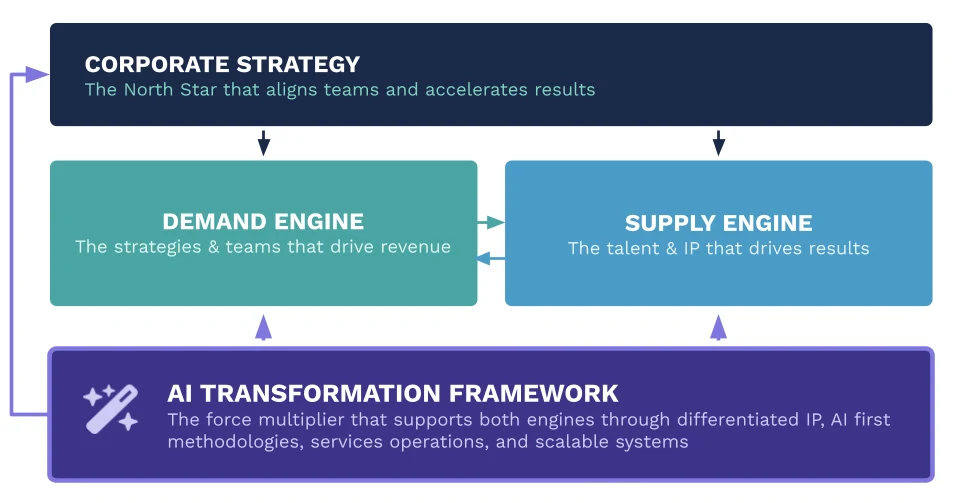
Corporate and Organizational Strategy: Every company needs a North Star. We help leadership teams decide where to play, how to win, where to focus limited resources, and how to structure the organization to deliver on the strategy.
Go-to-Market Acceleration: Sometimes the strategy is sound, but the growth engine isn’t working. We help firms sharpen their positioning, offerings, target markets, partner strategy, marketing and sales execution, and the connections between teams.
Delivery Optimization: Growth isn’t valuable if it leads to unhappy clients, burns out the team or destroys margins. We help firms improve how they grow and structure talent, manage clients and margin, and build repeatability and IP into their offerings.
AI Transformation: AI is reshaping every aspect of services. We help firms evaluate and implement an AI transformation framework that methodically builds AI maturity across the business — from internal processes, to pricing and productization, to entirely new operating models.
Why Now? An Industry at a Crossroads
It’s an exciting time to be in technology services, but it’s also an uncomfortable one.
AI is opening up enormous new opportunities for firms, but it’s also automating work that services firms have traditionally been paid to do. That is putting real pressure on the business.
Software vendors that were once primary growth drivers for firms are now building more implementation capability into their products. Even building out their own services capabilities internally to drive consumption and capture more top-line growth.
AI-native competitors are coming into the market quickly with smaller teams, different economics, and promising faster results. Buyers are starting to question whether large project teams and long timelines are really necessary.
In the next 18 months, we’ll see a services renaissance for some firms and a services recession for others.
In the next 18 months, we’ll see a services renaissance for some firms and a services recession for others. The market will bifurcate between those that continue to sell largely undifferentiated labor, and those who move up the value chain and automate commodity work with AI. The winners will be those that bring real domain expertise, that build repeatability into their work, price for results, and use AI to improve how they run the business and to solve entirely new problems.
It’s a dynamic that we talk about in our new research report, “Where Services Can and Should Play in the AI Era” that you can download here.
Experience Matters at a Crossroads
Today, AI can generate a perfectly respectable strategy framework in seconds, but it often fails in the face of reality because of nuances a machine hasn’t factored in. Benchmark data is easy to find, but it’s rarely a perfect fit to a business and can often guide people in the wrong direction.
Information isn’t a scarce resource anymore. It’s judgment. Knowing which questions to ask. Recognizing when a problem is a temporary versus a sign that the strategy has run its course. Understanding the second- and third-order effects of a decision. Knowing which conventional wisdom to follow and which to ignore.
That kind of judgment comes from doing the work, making mistakes and seeing how decisions play out over time. It comes from scar tissue, which our team has.
Judgment comes from doing the work, making mistakes and seeing how decisions play out over time. It comes from scar tissue, which our team has.
The Tercera team and our curated community of Advisors brings more than 30 years of experience building, scaling and selling services companies. As investors, we speak with hundreds of founders, software companies, bankers and other investors each year.
We know what the next generation is doing differently. We see which models look exciting on paper but struggle in the real world. And we understand the capabilities buyers and software partners are beginning to value, and which ones are losing relevance.
Technology services firms deserve a partner who understands that these businesses aren’t software companies with lower margins. They have their own economics. Their own customer, team and partner dynamics. Their own operating rhythms. Those economics, dynamics and rhythms might be shifting, and in some cases look more software-like. But these are still people businesses. And we’re the people who understand them.
If you think we can help, we’d love to hear from you.