

There is an assumption right now that all services firms need to do is pick the right AI vendor to partner with and growth will come. Perhaps that’s why virtually every firm we speak with has announced, or is working on, a shiny new Anthropic partnership. Although to be fair, if we were to pick a foundational AI partner to bet on right now, it would be Anthropic.
On the surface, this logic makes sense. Get in early with the perceived winners, retrain staff and double down on certifications, announce a practice around said platform, and ride the wave. However, this narrative misses how unstable the AI playing field actually is right now.
However, this narrative misses how unstable the AI playing field actually is right now.
AI technology is advancing at a pace that makes it difficult to know which vendors and capabilities will be differentiated six months from now, much less three years from now. When SaaS and cloud platforms first came to market, we marveled at the pace of change from on-premise software. New releases and platform updates went from happening every 18 months to every 6 months, then 3 months. However, in 2026, the frontier labs are releasing meaningful model releases or updates every few weeks.
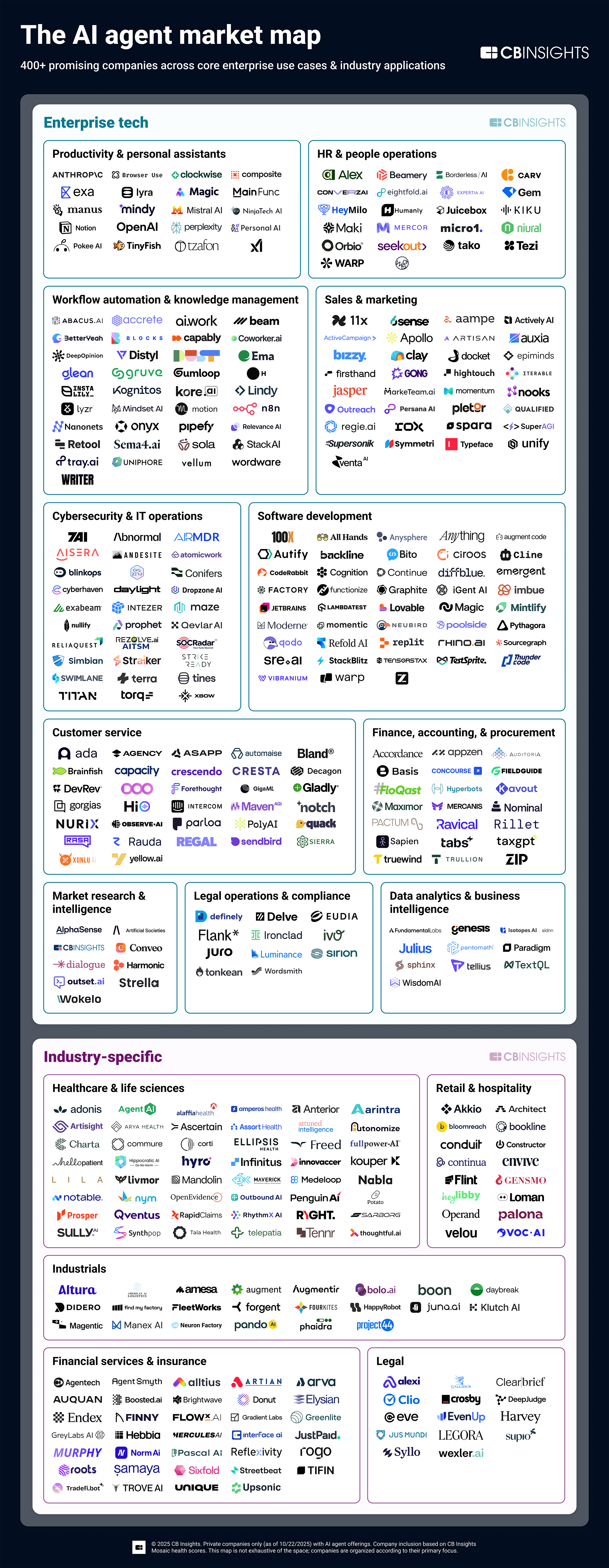
It’s not just the frequency of model advancements. It’s also the shifting happening inside the categories as vendors rush to take advantage of this new world. AI-native and traditional software and hardware vendors are moving up and down the stack, creating both new opportunities and risk for partner. Product categories are blurring together, and new players are multiplying faster than most firms can reasonably track. This AI agent market map (aka: eye chart) from CB Insights – and that was from 2025!
Navigating The Unstable Landscape
Choosing a go-to-market partner, or even a more technically oriented solution partner, in this environment can be extremely challenging. Some of these AI players will go on to become major platforms. However, many will get acquired, absorbed into broader offerings, or simply disappear. That’s a tough pill to swallow when firms have invested money, human resources, and perhaps most importantly, valuable time into building these relationships.
Even when you’re betting on one of the power players in AI, it can be tough to know who exactly to bet on. In early 2025, it looked like OpenAI was unbeatable. A year later, Anthropic is surging in the enterprise, by many reports, pulling ahead of OpenAI in both annualized revenue and breadth of partnerships. In 2025, Microsoft had a clear built-in advantage. Yet in 2026, Google seems to be making significant inroads with both enterprises and their partner ecosystem. We’ll cover this more in our 2026-2027 Tercera 30 research coming this Fall.
None of this means that firms should stand down and wait it out. In fact, that is the worst thing you could do.
It also doesn’t mean that technology partnerships are becoming less important. Deep relationships with the right vendors still matter enormously. Channel partnerships can be one of the most efficient and fastest ways to break into new accounts, and customers appreciate firms that have an opinion on which vendors are best for their domain and their specific problems.
The difference is that in the AI era, a partnership is an ingredient in the strategy. It is not the strategy itself.
As the market and vendor landscape evolves, so must a firm’s strategy and partnerships. Not every month. After all, great relationships can take years to build, and pivoting strategies too often is a sure-fire way to confuse your team, customers and the market. But if leaders aren’t continuously monitoring what’s happening in the market, their client base and the vendor landscape given how quickly things are moving, the strategy and partner strategy that worked two years ago may no longer be the best path forward.
If leaders aren’t continuously monitoring what’s happening in the market, their client base and the vendor landscape given how quickly things are moving, the strategy and partner strategy that worked two years ago may no longer be the best path forward.
This is one of the topics we tackle in our newest report, Where Services Can & Should Play in the AI Era. The report lays out a practical way for services leaders to think about the AI landscape, understand how the vendor ecosystem is evolving, and prioritize where to invest rather than jumping on the latest bandwagon.
If you haven’t downloaded the free report, we’d encourage you to check it out here.