
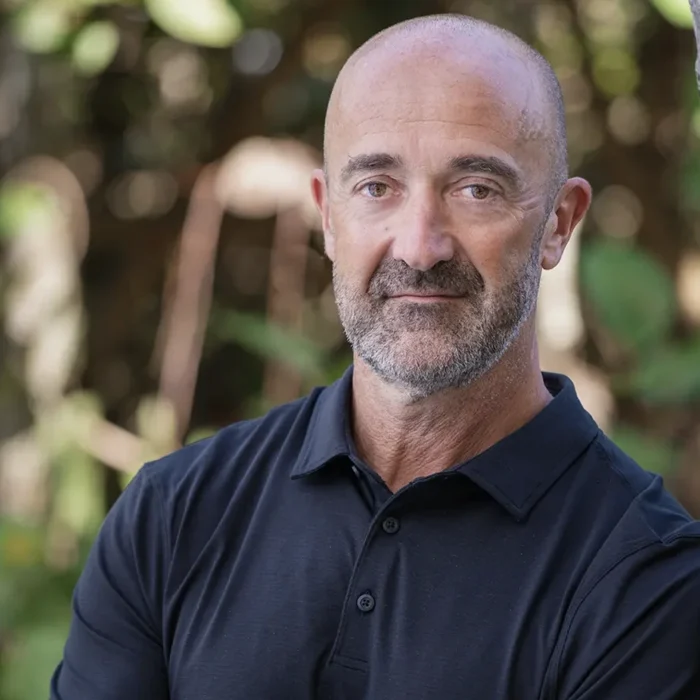
Today, at the crack of dawn, I’ll push off from Monterey, California in a 23-foot rowboat and begin a 1,500+ mile journey to Punta Mita.
No engine. No sail. No support boat. No real coffee. Just me and the Pacific Ocean for about 45 days (give or take).
On paper, this might sound like a physical endurance challenge, and in some ways it is. However, it is much more about mental endurance. The body will do what it’s trained to do. The harder part is what happens in your head when conditions turn, when progress slows, when you’re alone with your thoughts for days at a time.
And that’s really what this row is about.
This journey is about shining a light on men’s mental health, a deeply personal cause that I will explain shortly, and testing my own mental endurance. Out on the ocean, there’s nowhere to hide from yourself. It’s about learning how to sit with discomfort, how to process it, and how to keep moving forward in a healthy way, even when conditions are outside your control and you aren’t sure what the next best move is.
Choosing to Step Into Uncertainty
We spend a lot of time in our professional lives trying to create certainty – building plans, forecasting outcomes, managing risk. And yet, the environments we operate in today are increasingly unpredictable. Markets shift. Technology evolves. Assumptions break. I’ve always said those who thrive aren’t the ones with the most rigid plans, but the ones who can adapt in real time.
We spend a lot of time in our professional lives trying to create certainty, and yet, the environments we operate in today are increasingly unpredictable. Those who thrive aren’t the ones with the most rigid plans, but the ones who can adapt in real time.
We talked about this at our recent Tercera leadership retreat: the idea of adaptive leadership. At its core Adaptive Leadership is having the ability to thrive in uncertain environments, to know what risks are worth taking, and to mobilize the people around you to focus on what matters most. For the next 45 days, what matters most is staying safe, physically and mentally healthy, and raising $1 million for a cause I care deeply for.
Understanding My “Why”
I often get asked why do it?
The answer is that the rewards aren’t what you might expect. It’s not about the finish line or the distance. It’s about what happens in between. The ocean has a way of stripping things down to what matters. There’s no noise, no meetings, no constant input. Just time, effort, and your own thoughts. It’s a reset, mentally and physically, and a reminder of how much clarity can come from stepping away.
My father died early of heart failure. And I’ve seen firsthand how easy it is, particularly for driven people building companies, to neglect their own mental and physical health in the process. The focus becomes the business, the team, the outcome. Everything else gets pushed aside. But the reality is, if you’re not taking care of yourself, you can’t show up for anyone else. You can’t lead effectively. You can’t sustain what you’re building. At some point, you have to put on your own oxygen mask.
If you’re not taking care of yourself, you can’t show up for anyone else. You can’t lead effectively. You can’t sustain what you’re building. At some point, you have to put on your own oxygen mask.
Yet the primary reason is related to the causes that I’m rowing to raise money and awareness for – mental health and addiction recovery.
These two issues have shaped my life in ways that took years to fully understand. My father, my brothers, and my son have all been impacted in different ways. For a long time, like many families, it wasn’t something we talked about openly. It was something we navigated quietly, often without the right tools.
I believed, as many do, that my role was to provide, protect, and stay strong. But over time, I’ve come to understand that strength without presence has blind spots. And those blind spots can matter more than we realize, especially for the people closest to us.
Project Healthy Minds and Providence Farm are two organizations that got my family and I through some challenging times. Project Healthy Minds is working to make it easier for people to find and access mental health resources. Providence Farm is a sober living community for young men in recovery. Both are focused on something we need more of: practical, accessible paths to support and recovery.
Preparing for 45 Days Solo Rowing
The ocean is unpredictable. There is a non-zero chance of being speared by a marlin or hit by a tanker while I sleep. And there’s the isolation of being alone for weeks, away from family, friends, my team, even my dog. My preparation wasn’t about eliminating the risk, it was about learning how to minimize them as much as possible. Preparation is how you thrive in uncertain environments. That and putting the right team around you.
I’ve spent 18 months working with an incredible coach, Tez Steinberg. Tez was a keynote speaker at our 2024 Tercera Leadership Retreat, and after hearing his story about how he made it through 197 nights solo at sea, even after a heart attack, I was hooked! Since convincing him to take me on, I’ve spent months learning from experts about wind and weather patterns, doing endless hours of Tez tasks to master the boat and prepare for what it will be like solo at sea. At this point, much of the physical effort is muscle memory. I understand the risks, at least as much as you can without having lived them.
Strong teams, like strong leaders, are built to operate without a single point of failure.
What makes that possible, at least for me, is knowing that the foundations are in place. At home and at Tercera, I’m surrounded by people I trust deeply. We’ve planned for this. We’ve run the scenarios. The firm doesn’t depend on me being present every day, and that’s by design. Strong teams, like strong leaders, are built to operate without a single point of failure.
What’s Next
While I’ll be physically alone for much of this journey, it’s not something I’m doing alone. It’s been shaped and supported by family, friends, mentors, and a broader community that believes in the mission behind it. And I am deeply grateful for the support that team Tercera and Trilantic have given throughout this journey that have allowed me to do this.
This support is a reminder I carry with me heading out to sea. First, none of us have to navigate hard things on our own. Second, it’s about what we learn from the journey, and how we show up when we come back.
If you want to follow my row or support the mission, you can find more info at cbrows.com.