

Each January, the Tercera team lays out the trends that will shape tech services in the coming year. Last year, we had 10, ranging from where we saw gusts of growth, to how talent, pricing and partner models were shifting in the AI era.
If you’re curious to see how those trends played out, you can check out that blog here.
This year, we’re forgoing the lengthy list of predictions. People are already so inundated with ideas and suggestions (much of it thoughtful but also a lot of generic AI musings) that we’re taking a ‘less is more’ approach to the year.
Which is why this year we’re focusing on a single concept that will shape so much of 2026 – Trust.
The Growing Trust Gap
Trust isn’t new, and to some it might seem ambiguously fluffy. However, it is the invisible but very real structure upon which all successful relationships are built. Whether we call it trust, credibility or reliance.
Trust isn’t new, and to some it might seem ambiguously fluffy. However, it is the invisible but very real structure upon which all successful relationships are built. Whether we call it trust, credibility or reliance, without it, collaboration crumbles, transactions cease, businesses falter and progress stalls.
Unfortunately, trust has been under attack and eroding for some time. The Edelman Trust Barometer has been tracking trust across governments, media and business for over 20 years. Their 2026 report highlights the continuous erosion of trust and reveals a world “retreating towards insularity”, driven by economic anxiety, geopolitical tension, misinformation and tech disruption.
AI, for all the benefits and potential for innovation it brings, is unfortunately exacerbating this trust gap. Our feeds are full of stories about AI-driven cyber breaches, AI-curated videos designed to drive dissonance, regular reports of how AI is killing [insert industry here] and rumors of a market meltdown brought on by an AI bubble.
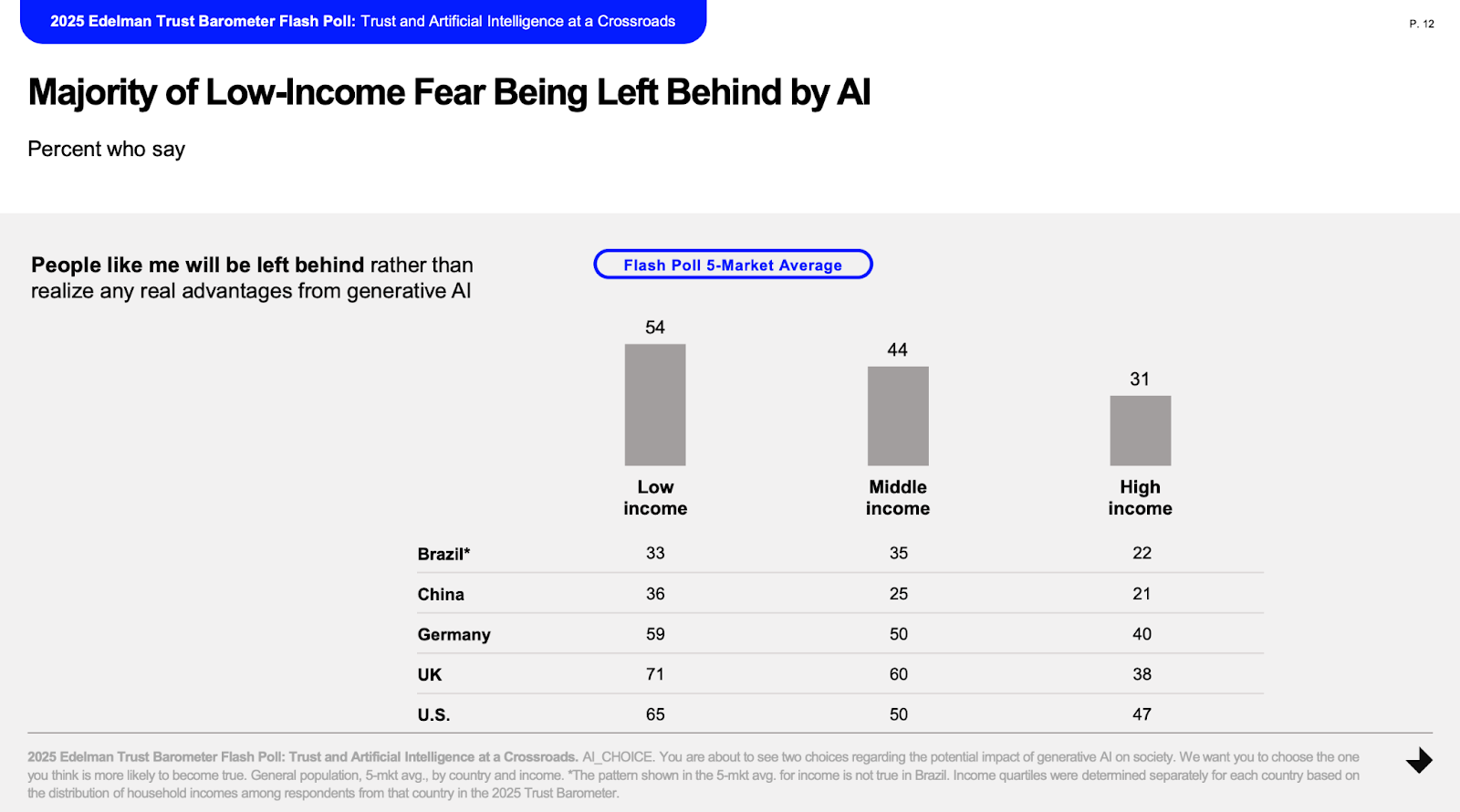
Employees are being pushed to adopt AI to automate aspects of their jobs and move faster, while at the same time reading about waves of layoffs driven by that same automation. It’s happening across every industry, but not surprisingly, impacting certain parts of the workforce more. About half of low- and middle-income respondents in Edelman’s trust survey say they fear that AI will leave people like them behind.
Buyers, too, are feeling the strain. They’re being barraged by well-funded AI startups promising faster, cheaper, and better outcomes. At the same time, their established technology partners position themselves as AI experts to protect market share, whether or not that expertise is fully baked. Pushed by boards to move quickly into AI to maintain their own relevance, many are moving forward before being fully ready or are stuck in experimentation mode.
With this in the backdrop, it’s not surprising that customers, employees and partners are questioning who and what they can rely on in a world increasingly shaped by AI. Yet, it’s within this chaotic and uncertain environment that people are looking for vendors, employers and partners who they can trust. The people, not the platforms, who can guide them, who will have their backs, and who will be in the trenches with them to navigate all this change and uncertainty. Those who can deliver on these promises are the ones who will be rewarded in 2026.
Where Services Shines
Fortunately services businesses deal in trust every day. They are seen as the trusted intermediaries for clients who need help with problems both large and small. A $1.5 trillion industry has been built on the back of being trusted advisors, subject matter experts and the voice of reason to act in the client’s best interest when ambition sometimes outpaces reality.
As AI reshapes services businesses from the inside out, those brands and trusted relationships are going to be tested more than ever. Every choice a services firm makes will either enhance trustworthiness or deplete it, from how they govern and secure client sensitive data, to which vendors they align with. From how they guide clients during difficult times to how they treat their own employees.
Services may be becoming increasingly tech-enabled, but these businesses are still built on human expertise and relationships. Those relationships can be more valuable than anything during times of chaos, but they are also more fragile than ever.
Trust must be actively earned and re-earned if firms want to extend their business into new areas like AI, which will be a requirement for future relevance. This human-built trust, when nurtured appropriately, can extend into non-labor based IP (products, accelerators, full platforms) that so many firms are developing as services and software boundaries blur. Services firms will now have a responsibility to carry their hard-won credibility into everything else they build and sell.
Accenture is a great example of this. While the business model of the GSIs is inarguably under pressure, Accenture seems to be weathering the storm quite well. Their fiscal first-quarter results reported in December exceeded expectations across revenue, margins and EPS. Q1 FY27 revenue continued to grow 5% YoY, while AI revenue increased 120% YoY to $1.1 billion in the quarter. This is a company that has spent decades and billions of dollars building up its brand and developing long-running client and partner relationships. That foundation has positioned them well in this era of tech disruption, even if they too are reinventing.
Signals that 2026 is the Year of Trust
Here are just a few of the signals that point to trust being the dominant currency in 2026.
First, we’re seeing trust move from an implicit expectation to an explicit requirement. AI usage policies, disclosure requirements, and governance language are increasingly showing up in contracts and sales requests as material points of negotiation. Board conversations are shifting away from just adoption and deeper into AI governance, auditability, and security for agentic actions. In some cases, these are becoming budgeted line items.
Second, we’re seeing more interest and investment around trust infrastructure, emphasizing new features, products and services focused on data traceability, observability, governance and compliance. As agentic systems move closer to core operations, this will only pick up.
Third, companies are rethinking how they show up in the market. We’re seeing an increase in brand marketing and earned media (PR, analyst relations) over traditional digital demand, and more focus on authentic, human-centered experiences such as intimate, in-person events. As generative AI floods feeds, some brands are even explicitly signaling “made by humans” or rejecting AI visuals to create trust and emotional resonance.
Finally, partner ecosystems are evolving. As AI use cases move deeper into business-critical workflows, channel strategies are shifting away from broad distribution toward trusted specialization. ISVs are leaning less on implementation generalists and more on industry experts who understand the nuances of the business. Companies that have earned customer trust and can drive real adoption and consumption of their platforms.
Scenarios To Watch in 2026
Trust will no doubt continue to be tested this year. How firms handle these tests will tell whether trust has been built into their operating system or is still just a sidenote. Here are a handful of scenarios we believe we’ll see over the coming year, and what we think the outcomes might be.
1: Big AI failures are coming, but the biggest firms will survive them.
As AI and agents push deeper into client work, errors will be unavoidable. We’ve already seen it in the high-profile Deloitte misstep last year, and we’ll no doubt see more. We believe most of the world’s largest professional services firms will experience at least one high-profile AI misstep. The question isn’t if something goes wrong, but how firms respond when it does.
The big firms will survive these missteps and continue to grow. Not because they’re immune to failure, but because they’ve built reservoirs of trust over decades. They have the relationships, operational discipline, and crisis-management muscle to absorb reputational hits, course-correct in public view and keep moving forward.
Trust acts as a buffer. For those with a trust reservoir built up, an AI gaffe will be a setback, not an existential threat. For less trusted players, the same mistake could be fatal.
2: AI agents gain traction, while the human experience differentiates
After a year of heavy investment and hype, we’ll finally see progress as more companies push agents into production and learn what actually works. But adoption won’t mean complete autonomy. The human-in-the-loop, and more importantly, the human experience built around these agentic use cases, will be all the difference.
As just one example, while agent-driven shopping will surely advance, customers won’t hand over control wholesale. Few people want an agent making independent purchasing decisions without context, confirmation or recourse. And, when something goes wrong, customers will still demand a human who can listen, empathize, and take ownership. If they can’t reach one, trust evaporates quickly.
Services firms have a massive opportunity to help clients design experiences that differentiate while preserving accountability, escalation and trust.
3: The AI adoption curve starts to flatten
AI-native companies aren’t going to slow down in 2026. This group will continue to move full speed ahead, pushing boundaries, deploying agents aggressively, and accepting risk as the price of speed.
The laggards will also accelerate, seeing the need to catch up as competitive pressure mounts and gaps become impossible to ignore. But the group in the middle, the AI-enabled who have already deployed, will start confronting the hard realities of scale: data quality, governance, security, compliance, and operating models.
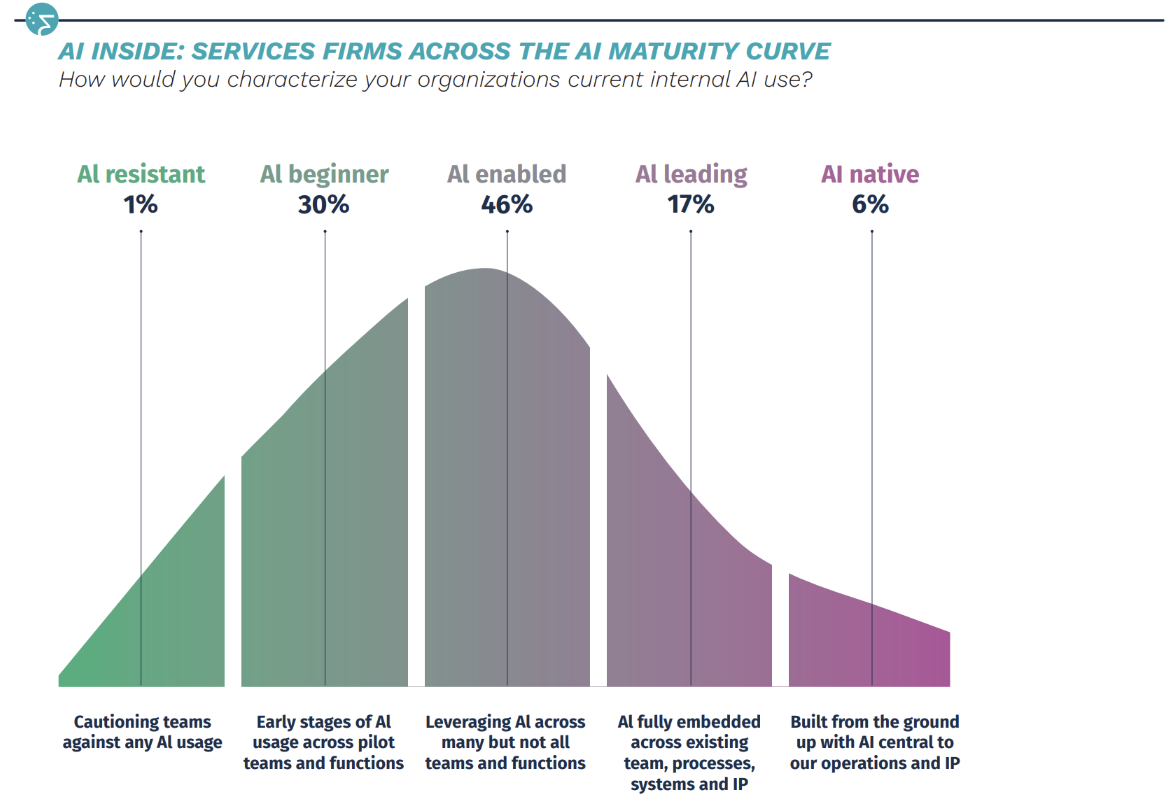
Many will realize they moved too fast, rushing pilots and early production use cases without a clear strategy or guardrails in place. We expect these organizations to take a more measured approach to AI adoption, not because it doesn’t work, but because they understand trust, governance, and readiness matter more than speed. It won’t be a retreat from AI, but rather a recalibration.
Welcome to the Year of Trust!
Over the course of the year, we’ll continue tracking how these scenarios evolve and what they mean for services leaders navigating an increasingly complex, AI-driven landscape.
Tercera is also actively looking to invest in services firms that have deeply embedded trust into their culture and operations, and are learning how to extend that trust into products and packaged IP. If you think we could be a good partner, we’d love to hear from you.
If you want to stay close to how the year unfolds, subscribe to the Tercera newsletter for ongoing analysis and insights as the Year of Trust continues to unfold.