

It has never been easier to produce a list of promising software companies. Ask an AI research tool for the fastest-growing vendors, the largest markets or the hottest AI platforms and you will get an answer in seconds. The harder question is whether a technology services firm can build a durable, differentiated and profitable business around one of those companies.
Put more simply: where should the next generation of technology services firms place their bets? That is the question behind the Tercera 30.
Since 2022, we have published an annual view of the software ecosystems we believe offer the strongest opportunities for technology services firms. The list is not meant to identify the best software products or the most valuable software companies. It is designed to identify ecosystems where outside services partners can create meaningful value and where that opportunity can endure as markets, buying behavior and technology change.
The Tercera 30 is designed to identify ecosystems where outside services partners can create meaningful value and where that opportunity can endure as markets, buying behavior and technology change.
In a few short weeks, we will have our selections for 2026-2027. Until then, here is a sneak peek into how we select the 30 vendors we ultimately profile.
Looking beyond the obvious names
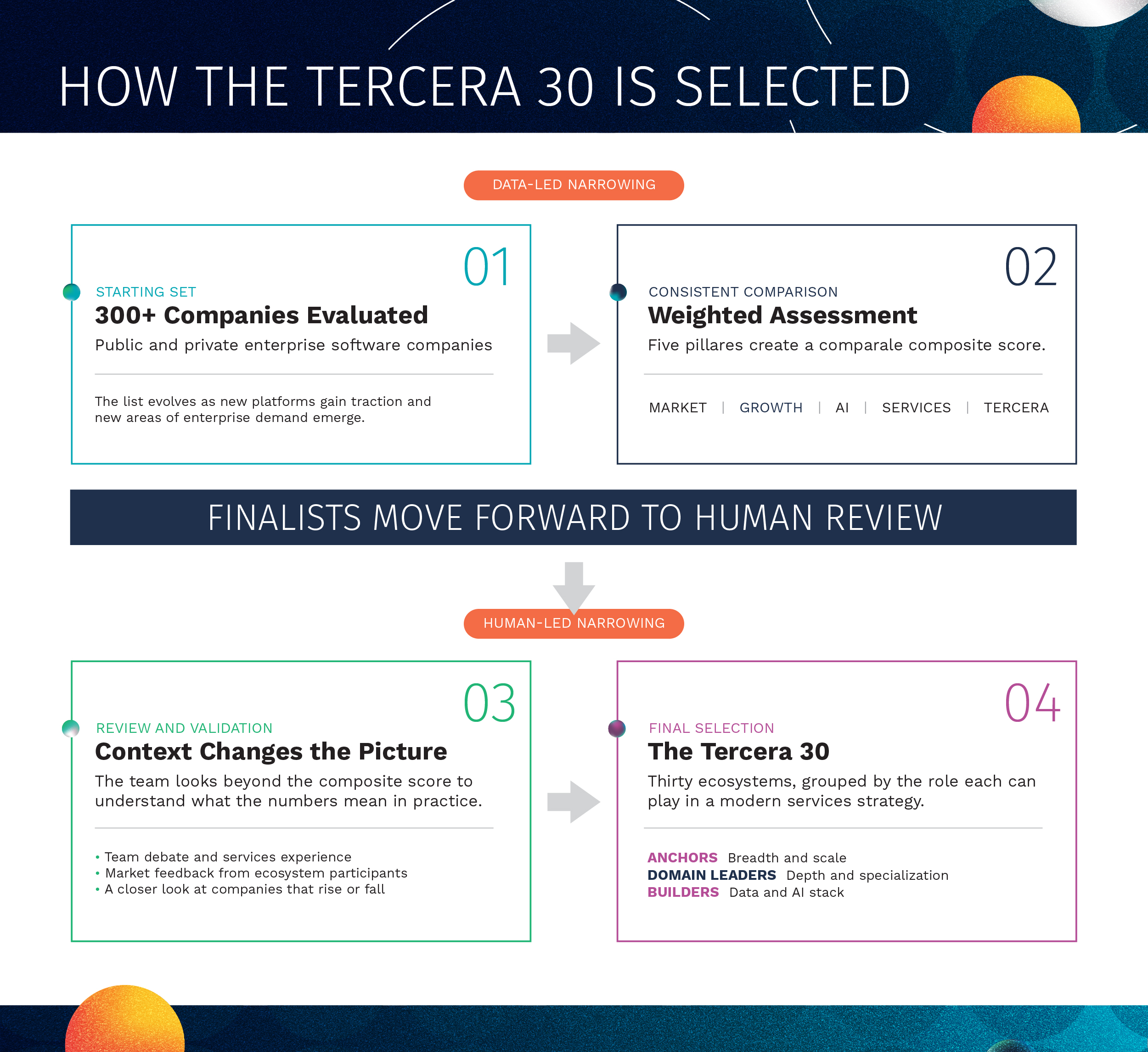
Each year, the group of companies we assess grows and evolves as new platforms gain traction and new categories of enterprise demand emerge. For the 2026 – 2027 Tercera 30, we started with 300+ public and private enterprise software companies. This group draws on several years of research and trend data and ongoing input from services leaders, portfolio executives, bankers, analysts and enterprise buyers. We add companies as they appear more frequently in client conversations or begin creating meaningful opportunities for services firms.
From there, we collect and cross-check thousands of data points. Financial performance, market growth estimates, analyst and peer ratings, funding and acquisition activity, employee trends, product investment, partner program details, and ecosystem growth and maturity all contribute to the picture. We triangulate across sources such as FactSet, SourceScrub, Gartner, G2, company filings and websites, as well as ISV and CEO interviews, a survey of 300+ services partners and direct market feedback. That matters because no single source tells the full story – especially when public and private companies are being evaluated together.
Five pillars to evaluate each vendor
For 2026, we evolved the methodology into five weighted pillars. Each asks a simple question about whether a company can support a strong and lasting services ecosystem.
The weighting is deliberate. Growth Quality and Services Opportunity carry the most weight because a large market or strong product is not enough. The company must have the momentum to support a growing ecosystem, and outside firms must have enough room and vendor support to build valuable, repeatable work around it.
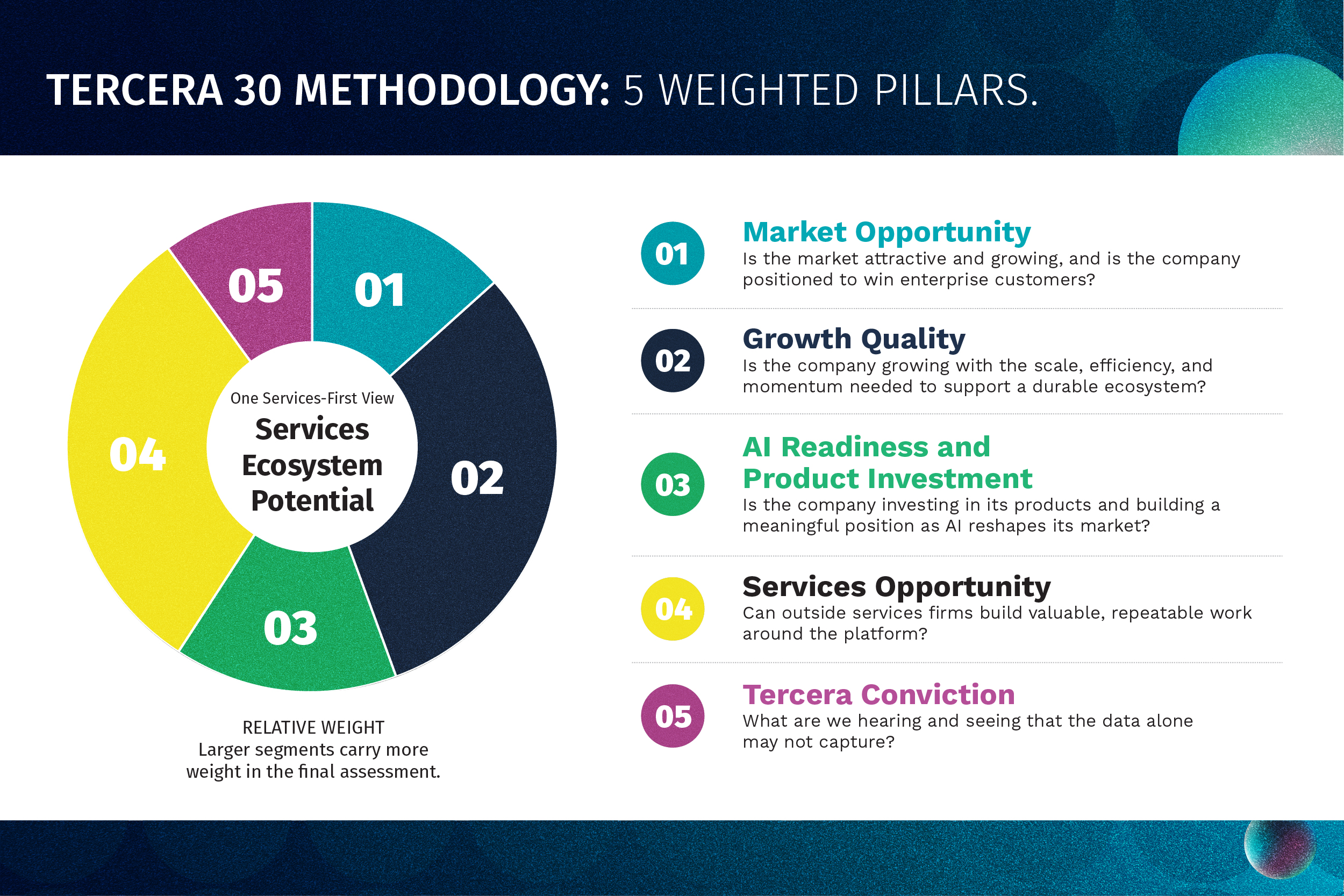
Taken together, the five pillars help us look beyond which companies are growing fastest and focus on where services firms have the strongest opportunity to build lasting value.
From score to selection
The weighted model gives every company a consistent composite score and helps us narrow a much larger universe to a more manageable group of finalists. But a spreadsheet does not select the Tercera 30.
We review the results as a team, debate where the data may be lagging the market, and take a closer look at the companies that rise or fall. We then test our thinking with people operating in these ecosystems including services leaders, portfolio executives, bankers, analysts and other market experts.
This is where context and 30+ years of experience in services becomes critical. A large partner count, for example, can signal opportunity or saturation. Fast vendor growth can create demand or hide a model that leaves little room for outside services/partners. The score gives us a consistent starting point, but experience and market feedback help us understand what the numbers actually mean.
The Tercera 30 has never been static. As markets, technologies and partner models change, so do the names on the list, the signals we assess and the categories we use to explain the opportunity. Earlier editions were built largely around a single-vendor premise: identifying platforms around which a services firm could build a thriving standalone practice. AI is reshaping software, services and enterprise buying patterns, making that single ecosystem growth model harder to sustain.
Clients increasingly need partners that can orchestrate multiple platforms, data and agents around specific business outcomes. This requires combining broad platform relationships with deep domain expertise and capabilities across an increasingly interconnected data and AI stack.
AI is reshaping software, services and enterprise buying patterns, making that single ecosystem growth model harder to sustain.
That shift is reflected in how we organize this year’s final 30. Rather than treating every ecosystem as the same type of opportunity, we group the companies into three categories based on the role each can play in a modern services strategy. These categories are not tiers of good, better and best. They represent different kinds of opportunity.
- Anchors offer breadth and scale. These are platforms around which a firm can build a substantial practice, often across multiple buying centers.
- Domain Leaders offer depth and specialization. They give firms a strong point of entry into a particular business function or industry, typically as one strategic partner within a broader solution.
- Builders represent important parts of the data and AI stack. A firm may not build a standalone practice around these Builders, but having capabilities around these technologies is becoming increasingly important to enterprise AI strategy and delivery.
We will unpack these categories, and the companies within them, in the full report.
The role of AI in the Tercera 30
AI has made our research process faster and more expansive. Over the last year we’ve used it much more extensively to organize information, compare companies consistently, cross-reference claims, flag missing evidence and challenge our assumptions. It helps us see more and test more.
It does not make the final call. People still set the methodology, judge the quality of the evidence and make the final selection. Ecosystem strategy is full of signals that remain difficult to capture in a database such as how a vendor behaves with partners, whether customers actually want third-party help, where services demand is emerging, and whether an ecosystem can support differentiated services and attractive margins. Those judgments require human oversight and experience.
That combination of structured data, AI-assisted analysis and informed human judgment is what turns a list into a point of view. It allows us to look beyond which software companies are gaining momentum and focus on the question that matters most: where can the next generation of services firms build durable, differentiated and profitable businesses? The 2026-2027 Tercera 30 is our answer to that question, highlighting the ecosystems we believe offer the strongest opportunities for the years ahead.