

Everyone agrees that outcome-based pricing – the ability to get paid on results, not hours – is where the industry needs to go. But even the most sophisticated players are having a hard time getting there, despite the fact that it’s been on the radar for more than a decade. Even at McKinsey, an AI-forward firm that has been vocally advocating for this move for years, only about a quarter of client fees are currently tied to outcomes.
Most of the mid-sized IT services firms we speak with still derive the majority of their revenue from Time and Materials (T&M) based pricing. Most of them are exploring the move to alternative pricing models like fixed-fee, milestone-based pricing, or the holy grail of outcome-based pricing, but there is a reason why so many companies are stuck with T&M arrangements. It’s hard to make the shift.
What has changed is the pressure to act. With AI compressing delivery hours by 30–50% across many services workflows, clients expect more output with fewer resources. They see AI gains happening within their own businesses and are being pitched by services firms that claim to deliver work faster and cheaper by leveraging AI in their delivery processes.
If you aren’t using AI in your delivery processes, you may have a hard time competing or need to discount to win the work. If you are using AI but are still pricing based on hours, your clients are capturing all the productivity gains instead of you.
If you’re not feeling the pain of revenue reduction yet, you will soon.
And if you’re not feeling the pain of revenue reduction yet, you will soon. A recent Bain & Company report suggests that businesses that continue to operate with a business-as-usual approach could see revenues erode by 30% or more as work gets automated or replaced by AI. Firms that don’t evolve in this AI era will see profits decline as they need to discount and lower prices to win more work.
Why is it so hard to make the move to outcome-based pricing?
The simplest reason is that selling and delivering IT services is difficult, and pricing is even more so. Many factors can impact the success of a services engagement, many of them outside any one group’s control.
Even when things go well, clients often feel like they’re paying too much for what they get. When things don’t go well, it can be worse. Take the high-profile dispute between Zimmer Biomet and Deloitte over a failed ERP transformation, where unclear expectations, shifting scope, and delivery breakdowns ultimately led to a $172M lawsuit and operational disruption.
Even beyond client dependencies, there are operational aspects within services businesses that can keep firms stuck in a T&M model. These could range from the profile and motivation of personnel in the business to a lack of visibility into project- and program-level metrics.
In April, we held a best-practices session with leaders from across our portfolio companies and Advisory clients on how they are making the shift. Leading the session was Tercera Advisor, Lori Williams, who has had a front-row seat to this shift as a long time cloud services executive and former CEO of Caylent, AWS’ largest independent partner.
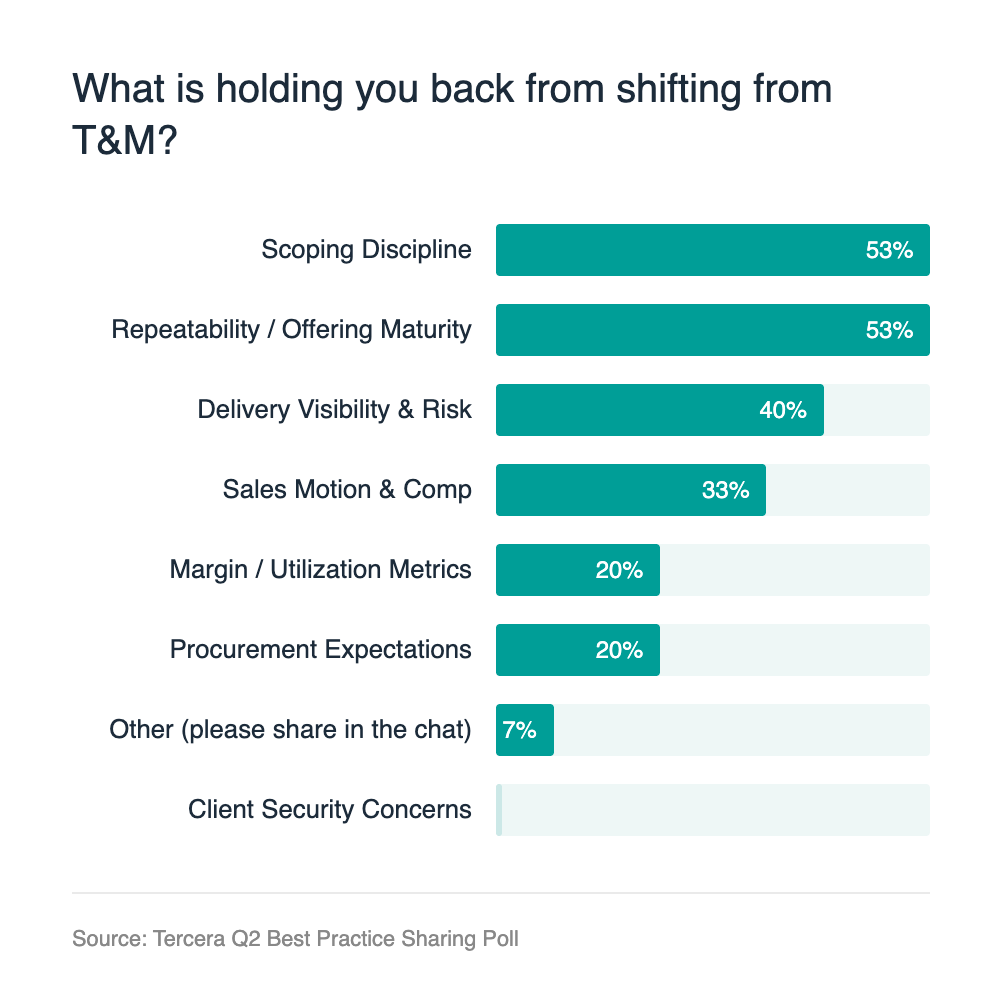
When we polled participants about what was holding them back from moving beyond T&M, there wasn’t a single answer. That is why the move is so difficult.
Momentum starts with the metrics, not the model
Our biggest takeaway from the discussion is that real pricing progress starts with understanding the current state and where firms are prepared to make the shift. And just as importantly, where they are not ready. While the long-term goal is to rewire the business to concentrate on reusable offerings and results, it often starts with baby steps.
Here are a few steps that have helped firms make the move from T&M to fixed-fee and ultimately to outcomes.
Reduce the emphasis on utilization
Utilization metrics on their own may now understate performance as teams can become much more efficient at the actual work. To be clear, this is still an incredibly valuable metric to track, but it can’t be looked at in a vacuum, as doing so can actually hide value or demotivate teams.
Utilization is still a valuable metric to track, but it can’t be looked at in a vacuum, as doing so can actually hide value or demotivate teams. Metrics like margin per engagement, cycle time and throughput now belong on the dashboard too.
Metrics like margin per engagement, cycle time and throughput now belong on the dashboard too. For example, Caylent now aligns incentives around gross margin by practice. The goal isn’t to ignore utilization entirely, but to focus on how efficiently and predictably the company can deliver results.
Capitalize on repeatability of offerings
Even if you can solve everything, it doesn’t mean you should. So much of what services businesses do is bespoke, but there are invariably things that firms have done over and over and over again. Know what these are and package established offerings into repeatable frameworks. Clearly understand how these offerings are sold, priced and delivered, and put ownership around the structure.
Hire for and nurture a product mindset
Packaging IP and repeatable offerings requires a product mindset and a solid understanding of the financial baseline of your established offerings. What do they actually cost to deliver, where are margins made or lost, and how does performance vary across engagements? With this insight, it’s possible to standardize and price with confidence. You can start turning individual snowflakes into scalable snowballs and capture the momentum you build.
Packaging IP and repeatable offerings requires a product mindset and a solid understanding of the financial baseline of your established offerings. With this insight, it’s possible to standardize and price with confidence.
Adopting a product mindset will impact the kind of people you hire. Traditional account executives and project managers often come in with a transactional mindset, and the mantra has always been to think like a service company, not a product company. That no longer holds.
As tech services firms shift to selling outcomes, they need to start thinking and operating beyond activities and deliverables. This will require spending more time scoping engagements up front and truly understanding the business impact of your work.
However, the change doesn’t stop with the statement of work. Salespeople and client managers need to sell and manage the outcomes throughout the delivery process. They must own the results, not just the plans. This is a subtle shift, but a significant one to get right.
Turn your IP into products you can sell
AI can help develop reusable assets, including accelerators, templates and workflows, by codifying, automating and optimizing whatever and wherever you can. This is a great way to combat compressed delivery times and recapture the value leaking out of your T&M model.
Not only will this de-risk delivery by embedding proven approaches into every engagement, but it also creates a new value layer that can be priced and sold independently of labor.
Not only will this de-risk delivery by embedding proven approaches into every engagement, but it also creates a new value layer that can be priced and sold independently of labor.
Train teams to be clear on outcomes and milestones
Clients are already asking for faster results and lower prices based on AI; together this is driving real revenue compression. Get ahead of it by shifting the conversation from effort to impact.
By anchoring pricing to business outcomes like cost savings, time-to-market, or customer performance, or throughputs such as units delivered, milestones achieved, or velocity gained, you can reframe the value offered. And you can position that value to expand, not contract, as delivery becomes more efficient.
It gets harder before it gets better, but it’s worth the journey
Shifting away from time and materials introduces real complexity. Revenue forecasting becomes less straightforward. Delivery teams need deeper visibility into progress, margin, and performance, and not just at the project level, but across the entire portfolio. Percent complete, as-sold vs. as-delivered margin, and governance discipline all matter more when you’re sharing risk with clients.
Percent complete, as-sold vs. as-delivered margin, and governance discipline all matter more when you’re sharing risk with clients.
But the payoff can be significant.
Orium, an agentic commerce and digital experience consultancy, has seen this first-hand. Over the last year, the firm redesigned pricing around fixed-fee engagements to better leverage the agentic tooling it had built both internally and for customers. To make the shift, Orium standardized contracts, building in the ability to substitute digital or agentic labor without reducing contract value. It got much more granular on delivery metrics, and spent time with teams helping them with the transition.
The transition wasn’t overnight. Orium migrated deal by deal, starting small with projects they had confidence they could deliver predictably, and scaling once the model proved itself. Within eight months, more than half of new revenue shifted, increasing revenue per delivery FTE by over 40% while making revenue more predictable and refocusing client conversations towards outcomes and milestones rather than hours.
Orium isn’t done. Outcome-based pricing with agentic on top is the next step. But with the fixed fee foundation, it’s positioned to fully capitalize on the value it delivers to clients.
Still stuck?
If you’re thinking about how to make this same type of shift in your own services business, Tercera Advisory works with services firms to redesign operating models for the AI era. If you think we might be able to help, contact us here.