Two technology services firms can buy the same AI tools, encourage the same experimentation, and promote “AI-first” messages to the market, yet end up in very different places.
At one firm, AI remains a fragmented technology initiative. The company purchases licenses, launches pilots, and rolls out AI tools across different functions without a clear plan for scaling what works and containing the risks. Individual teams may capture localized gains, but silos continue, and duplicated experiments and unchecked spending create mounting AI debt that grows unnoticed and ungoverned.
This is an increasingly dangerous place to be. Especially now that clients expect partners that can use AI to unlock competitive advantage, as well as use it to deliver work faster, smarter and at a lower cost. Firms that continue selling and delivering the same way risk losing differentiation, pricing power, and margin.
At the second firm, AI reshapes how the entire business works, transforming the organization function by function. Sales and marketing are redefining go-to-market strategies around clients’ evolving needs and new AI-enabled offerings. Delivery is embedding AI into its methodology and turning repetitive activities into reusable IP. And the operations team is automating workflows and strengthening decision-making. Employees understand how AI applies to their roles and are enabled to use it, and leaders can see which investments are driving revenue, margin, or strategic advantage.
The difference between firm 1 and firm 2 isn’t the technology. It’s the operating system around it.
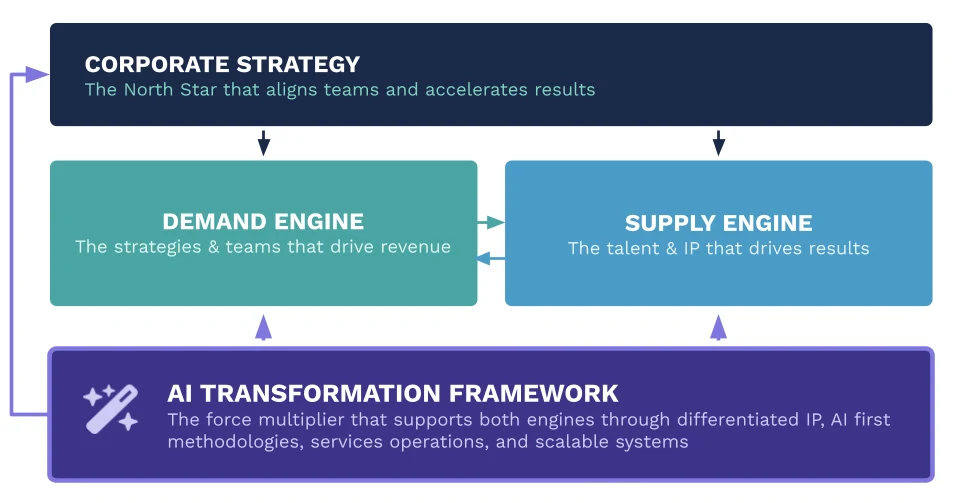
Firm two uses an AI operating system to connect AI initiatives across strategy, go-to-market, delivery and operations, and perhaps most importantly, to enable the talent that is still a services firm’s most meaningful asset. Such a system is the key to capturing the gains from experimentation and turning them into coordinated progress and, ultimately, top- and bottom-line impact.
If your organization sounds more like firm one than firm two, look for these 5 signs that your ad hoc approach may have run its course.
Sign 1: AI-enabled delivery isn’t improving the economics
Revenue per employee and margin are where the rubber meets the road for services firms. If delivery is “AI-enabled” but execution isn’t getting meaningfully faster or growth is still scaling linearly to headcount, something is missing.
Ultimately, a firm that has invested in AI across teams should see clear signs in the bottom line if it’s working, such as increased revenue per employee or gross margins closer to the 50% range than the 30% range.
While more revenue and higher profits might be the ultimate return on investment, remember that these can be lagging indicators. Investments in new offerings, enablement, and infrastructure can suppress profitability in the near term. Which is why leaders also need to track the signals that make stronger financial performance possible:
- Offerings and delivery models evolving with AI
- Reusable capabilities and cross-functional workflows scaling across the business
- Ownership, governance, and incentives supporting adoption
If those signals aren’t emerging, AI is still creating isolated gains without becoming a coordinated enterprise capability.
Sign 2: AI has changed the message, but not what you offer
AI claims are everywhere. But if service offerings, statements of work, pricing models, and the client experience look much as they did two years ago, then the transformation is more narrative than real.
AI should change not only how services firms execute work, but also the problems they solve and how they package value.
AI should change not only how services firms execute work, but also the problems they solve and how they package value. This means pre-AI offerings need a fresh look: A client that once bought a full-stack product from one vendor may now use AI agents to automate processes across a multi-vendor environment.
That changes where a services firm can add value, and which partners, capabilities, and commercial models it needs. If AI isn’t showing up in the offering portfolio and customer experience, one-off delivery efficiencies are unlikely to create durable differentiation.
Sign 3: Productivity gains depend on individual initiative
It’s encouraging when your teams use AI to work faster, but it’s limiting when those gains stop with the individual.
In delivery, this appears as project teams using different tools with no consistent methodology, reusable IP that isn’t managed or used across teams, or agents that slowly drift or go unused. But the issue extends across the organization. Marketing may generate content faster while remaining disconnected from sales, resulting in AI slop and brand degradation. Market and customer insights may never inform account planning or offering development.
A strong AI plan can break down those silos. Teammate agents and cross-functional workflows can bridge handoffs, give delivery a greater role in selling, and feed market intelligence back into the portfolio. If AI makes individuals more productive but leaves end-to-end processes untouched, the firm is only optimizing tasks, not transforming the business.
Sign 4: There’s no unifying AI vision or roadmap
Leaders may describe the firm as AI-forward, but a deeper dive often reveals disconnected tools, pilots and processes. Different teams pursue their own priorities and tell completely different stories about what the firm is doing with AI. Activity isn’t lacking, but a shared view of what that activity is intended to accomplish is.
That shared vision is the North Star for a common roadmap that defines what should be tested, standardized, scaled, or stopped. It helps firms make real progress toward their AI ambitions while keeping their AI story from outpacing reality.
Sign 5: Ownership, governance, and people systems haven’t caught up
A shared vision still needs accountable owners and clear guardrails. Firms must define who makes AI-related decisions, which tools are approved, how employees may use client data, and what security and oversight requirements apply. When policies and decision rights are fuzzy, well-intentioned experimentation can inadvertently expose sensitive information, creating real risk for the business.
Employees also need training on safe use, a clear understanding of what AI fluency means for their roles, and well-aligned incentives and performance measures. Keep in mind that legacy incentives may actually work against adoption. For example, utilization-based bonuses that reward consultants for time spent on a task can discourage them from using AI to complete the same work faster. Employees may also be unsure whether or how to classify AI-assisted work as client-facing or billable time. Without clear guidance, employees may either underuse AI, or avoid disclosing when they do.
Three moves to begin building an AI operating system
Addressing these gaps is bigger than choosing a platform or appointing an AI leader. It requires dozens of connected decisions across the business, from what it sells, to how it delivers, how it operates, and how it equips and rewards its people. Three moves can provide a starting point.
1. Decide where AI will create value and establish cross-functional ownership. Determine where AI will create the strongest competitive differentiation: streamlined delivery, new offerings, reimagined go-to-market, or a combination of all the above. Connect those priorities to measurable outcomes, such as margin improvement or new revenue, while being explicit about tradeoffs: optimizing today’s margins can compete with investing in tomorrow’s offerings. Assign a cross-functional team to coordinate the work across the enterprise.
2. Create a centralized roadmap without eliminating experimentation. Experimentation is essential, but it needs to be done within boundaries that prioritize the highest-value opportunities and reflect the company’s shared AI vision. Determine what should be redesigned, standardized, or scaled. This includes practical mechanisms that need to change with a new operating model, like rethinking Level of Effort estimates, pricing, or enablement, or recognizing a percentage of billable utilization time for work on priority AI use cases. The impact on fundamental structures and operating rhythms, like planning, budgeting, and overall org design, must also be carefully considered.
3. Equip and align the people who will make it real. Define baseline and role-specific AI fluency, provide hands-on learning, and establish clear safe-use guidance and human oversight. Empower frontline managers with explicit permission (and accountability) to drive adoption within their teams. Call out and reward the innovators. Finally, ensure hiring, incentives, and performance measures support the behaviors the AI strategy requires.
Find out where your firm stands
Tercera Advisory has created a free, five-minute AI maturity diagnostic, designed specifically for IT services firms, that lets you quickly identify your biggest strengths and opportunities for replacing AI activity with real AI transformation.
You’ll receive an overall maturity score, a maturity rating across five key pillars of an AI operating system, and a view of the areas that may constrain progress or provide a foundation for scaling. It also includes resources to help you dig deeper.
So if any of these signs strike a chord, take the diagnostic and use the results as a starting point for moving beyond AI activity at Firm 1 and toward the coordinated AI transformation happening at Firm 2. And if you need a hand making that transformation stick inside your organization, you know who to call.